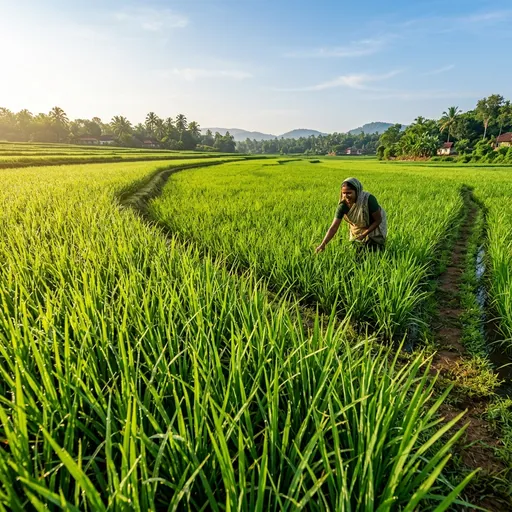
KHARIF 2025 · PADDY ALERT
Identify It Before Your Crop Burns — What Is BPH, and How Does It Devastate Your Paddy?
The complete truth about Brown Planthopper — essential reading for farmers, dealers, agronomists, and export buyers alike.
Heranba Industries Ltd. · June 2025 · 6 min read
| 514 Lakh Ha. | 60–100% | 7–10 Days | 2 Viruses |
|---|---|---|---|
| Total paddy area in India (2024–25) | Potential yield loss in severe BPH outbreak | Time for complete Hopper Burn to set in | Viral diseases transmitted by BPH to rice |
Section 01 — The Scale of the Problem
Paddy and BPH — An Old, Dangerous Relationship
India is the world's largest producer of rice. In 2024–25, paddy was cultivated across more than 514 lakh hectares, with total production reaching a record 150 million tonnes. These are numbers to be proud of — but every Kharif season, one pest has the capacity to undo all of that effort.
That pest is the Brown Planthopper, known as BPH or Nilaparvata lugens. It is not a new enemy — BPH was first recorded in India in 1950 in Tamil Nadu, and the country's first major outbreak occurred in Kerala in the late 1960s. Yet decades later, every Kharif season this insect continues to rob lakhs of paddy farmers across Andhra Pradesh, Telangana, Odisha, West Bengal, Tamil Nadu, and Eastern Uttar Pradesh.
The question is — why is BPH so dangerous? And why do we so often fail to identify it in time?
Section 02 — What the Pest Actually Does
BPH Does Not Just Feed — It Burns, and It Spreads Disease
BPH is a phloem-feeding insect — it sucks sap from inside the plant. Both adults and nymphs hide in dense colonies at the base of the rice tiller, just above the waterline. Looking down from above, the field appears completely healthy.
⚠ What Is Hopper Burn? As BPH population builds up, rice plants begin turning yellow suddenly. Round yellow patches appear and quickly turn brown and dry — this is "Hopper Burn". Once this condition sets in, an entire field can be reduced to ash in as little as 7 to 10 days.
But BPH does not stop at phloem feeding. It is also a carrier of two deadly viruses — Rice Grassy Stunt Virus and Rice Ragged Stunt Virus. This means that a single infected BPH, wherever it feeds, can leave behind a plant that later succumbs to viral disease — and there is no chemical cure for that.
The Real Yield Loss Figure: According to peer-reviewed published data, yield losses from severe BPH outbreaks can range from 60% to 100%, depending on variety and agro-ecological conditions. Infestation at the early stage (26–39 DAS) causes up to 8% loss; at the reproductive stage (40–53 DAS), documented losses exceed 70%.
BPH also reproduces rapidly. Temperatures between 25°C and 30°C, high humidity, and standing water in the field create perfect conditions for a population explosion — and Kharif season provides all three naturally.
Section 03 — The Real Problem Nobody Told You About
Why Are the Old Chemicals Failing?
This section is for the farmers, dealers, and agronomists who ask: "We sprayed Imidacloprid, yet BPH persisted." You are not alone.
| Insecticide | Mode of Action | BPH Resistance Status (India) |
|---|---|---|
| Imidacloprid | Neonicotinoid (Group 4A) | ⚠ Confirmed resistance — Karnataka, Andhra Pradesh, Tamil Nadu |
| Synthetic Pyrethroids | Sodium channel disruptor | ⚠ Causes BPH resurgence — destroys natural enemies |
| Buprofezin | Insect Growth Regulator | ⚡ Partial — reduced efficacy reported in several areas |
| Triflumezopyrim | Mesoionic (Group 4C) | ✓ Currently effective — monitor for resistance build-up |
| Beauveria bassiana (Bio) | Entomopathogenic fungus | ✓ No resistance reported — mechanism of action is entirely different |
Resistance to neonicotinoids such as Imidacloprid in BPH is a scientifically documented fact, confirmed across multiple districts in Karnataka, Andhra Pradesh, and Tamil Nadu. The bigger mistake, however, is the early-season use of Synthetic Pyrethroids like Cypermethrin and Lambda-cyhalothrin — these do little to control BPH but reliably eliminate its natural enemies: spiders, mirid bugs, and damselflies. The result? BPH populations explode even faster.
Note for Dealers and Agronomists: Farmers often try increasing the dose of a resistant molecule to force it to work again. This is not only ineffective — it is counterproductive. In a resistance situation, higher doses accelerate resistance, waste money, and increase soil and water contamination.
Section 04 — The Right Strategy
The Real Way to Control BPH — The IPM Framework
BPH management is not limited to spraying. An integrated approach is the only sustainable solution. Following the steps below in the correct sequence can reduce the BPH threat by 70–80%.
Choose a Resistant Variety — Plant BPH-tolerant varieties recommended by your KVK or State Agriculture Department. Inbuilt varietal resistance is the cheapest and most durable form of protection.
Maintain Correct Planting Geometry — Keep a 20 × 15 cm spacing for transplanted paddy. Dense planting creates the perfect microclimate for BPH to thrive.
Apply Nitrogen in Split Doses — Avoid heavy single applications of urea. Use three split doses — excess nitrogen increases BPH fecundity significantly.
Drain the Field at Maximum Tillering — Drain the field for 3–4 days at maximum tillering, and again before booting. This disrupts BPH habitat and population development.
Conserve Natural Enemies — Spiders, mirid bugs, and damselflies are natural predators of BPH. Avoid broad-spectrum insecticides during the early crop stage.
Scout Regularly — 46–66 DAS is peak outbreak time for BPH. Check the tiller base every week. If you observe more than 5 nymphs or adults per hill, take action immediately.
Section 05 — The Right Chemical at the Right Time
Mode of Action Rotation — The Real Answer to BPH Resistance
The solution to resistance is not to abandon chemicals — it is to stop relying on a single mode of action, season after season. When the same class of insecticide is applied repeatedly, BPH populations adapt and develop resistance to it. The answer is Insecticide Mode of Action (MOA) Rotation.
Group 4A — Neonicotinoids (Imidacloprid, Thiamethoxam): Resistance is confirmed in multiple states. Do not rely on this group alone. Use at most once per season if at all.
Group 9B — Pymetrozine / Flonicamid: Feeding inhibitors that disconnect BPH from the phloem. Minimal impact on natural enemies. An effective choice within a rotation strategy.
Group 4C — Triflumezopyrim: A newer molecule, currently effective in India. Rotation is still essential to prevent resistance build-up — do not use it every season.
Group 16 — Buprofezin (IGR): Prevents nymphs from developing into adults. Limited effect on adults. Useful at early infestation stages; include in rotation planning.
Group 2B — Fipronil: Blocks GABA receptors — an entirely different mode of action from neonicotinoids. A strong rotation option when other groups have failed.
📌 Golden Rule — IRAC: Never apply the same IRAC Group twice in a single season. If the first spray was from Group 4A, the second spray must be from a different group. This rotation slows the rate at which BPH develops resistance.
Avoid Synthetic Pyrethroids (Cypermethrin, Lambda-cyhalothrin) for BPH management entirely — they are not only less effective against BPH but actively kill the natural enemies that keep BPH populations in check. This has been documented by both IRRI and the Thai government.
Correct Spray Application for BPH:
Direction: Aim the spray nozzle at the base of the plant — BPH lives at the bottom, not the top.
Volume: Use adequate water volume to ensure the solution reaches the tiller base — surface spraying is not sufficient.
Timing: Spray in the morning or evening — efficacy drops under strong midday sun.
Threshold: Do not spray unless you observe more than 5 nymphs/adults per hill. Preventive spraying without scouting is wasteful and counterproductive.
Keep Records: Note which molecule was used, when, and how many times — essential for planning next season's rotation.
Key Takeaway
What Should You Do Right Now?
Kharif 2025 has delivered record paddy acreage. BPH, as it does every year, is ready to undermine that harvest. This time, you be ready too.
Between 46 and 66 DAS, step into your field. Check the tiller base. If you see more than 5 BPH per hill, act immediately — pick the right IRAC group, follow rotation, and stay away from pyrethroids. Adopting IPM is not a one-season decision; it is a commitment to the health of your entire farming system.
Knowledge is the most powerful input. Make the right decision — and protect your crop, your income, and your soil.
Heranba Industries Ltd. — Committed to delivering science-backed knowledge to Indian agriculture.
Tags: BPH · Paddy Kharif 2025 · Pest Management · IPM · MOA Rotation
Written by